Monday, August 20, 2012

The Native Gourmet Treat in Your Front Yard

www.distinctlyflorida.com/
Native Gourmet

Gracing parking lots and suburban yards is a gourmet delight so secret that you’ll swear it’s a conspiracy. Birds and squirrels know this hidden treasure but they’ll never tell. One online reference on how to tap into the succulent treat comes from a relatively unknown cay in Belize. Few Floridians have ever tasted its subtle sweetness and many don’t even know it can be eaten. This native south Florida shrub requires no special care, will flower on and off throughout the year and if left to grow into a small tree it will reward you with bountiful fruits. You can even crack open the six-segment central shell to get at the tasty nut (really a seed). Many will tell you the fruit will make a delicious jelly or jam, but try to find someone who has actually done it. What is this mysterious plant? The surprising answer is Chrysobalanus icaco, also known as cocoplum.


The fresh fruit can range from the size of a ping pong ball to as small as an olive and has a slightly sweet, mild flavor. The interior nut is pistachio-sized and is sometimes described as tasting like an almond, coconut, or peanut. The real magic happens when you cook the fruit with a little water and some cinnamon sticks. (The flavor resembles a really rich, deep grape with a berry finish.) The resulting juice can then be turned into dessert sauce, jam, jelly, candy, liqueur, brittle or even ice cream.

To make the jam, you will need at least 200 cocoplums. You can find them in city parks, along roadsides, in parking lots - any place the plants haven't been pruned too severely. The only caveat is to pick places where you are sure no pesticides have been used. (I usually go by the presence of insect life.) They are common in the wild and if you are out that way and not on a state preserve or national wildlife refuge, you can collect them there, too.


Wash the plums well and place in a pot with enough water to cover and two cinnamon sticks. Bring to a boil and simmer for about 1.5 hours. You may need to add water, so check on it every now and then. Soon your kitchen with fill with a heavenly aroma - your first hint at the delicacy to come.


Once the liquid is a dark purple and the fruits are soft, remove the pot from the heat and allow to cool. You will be separating the meager pulp from the nut for the next stage. I imagine there are machines that can separate the pulp from the pit, but I don't own one so I put on some clean gloves and squeezed the nuts free. This took a little while. The nuts are tasty on their own so I put them aside to dry.
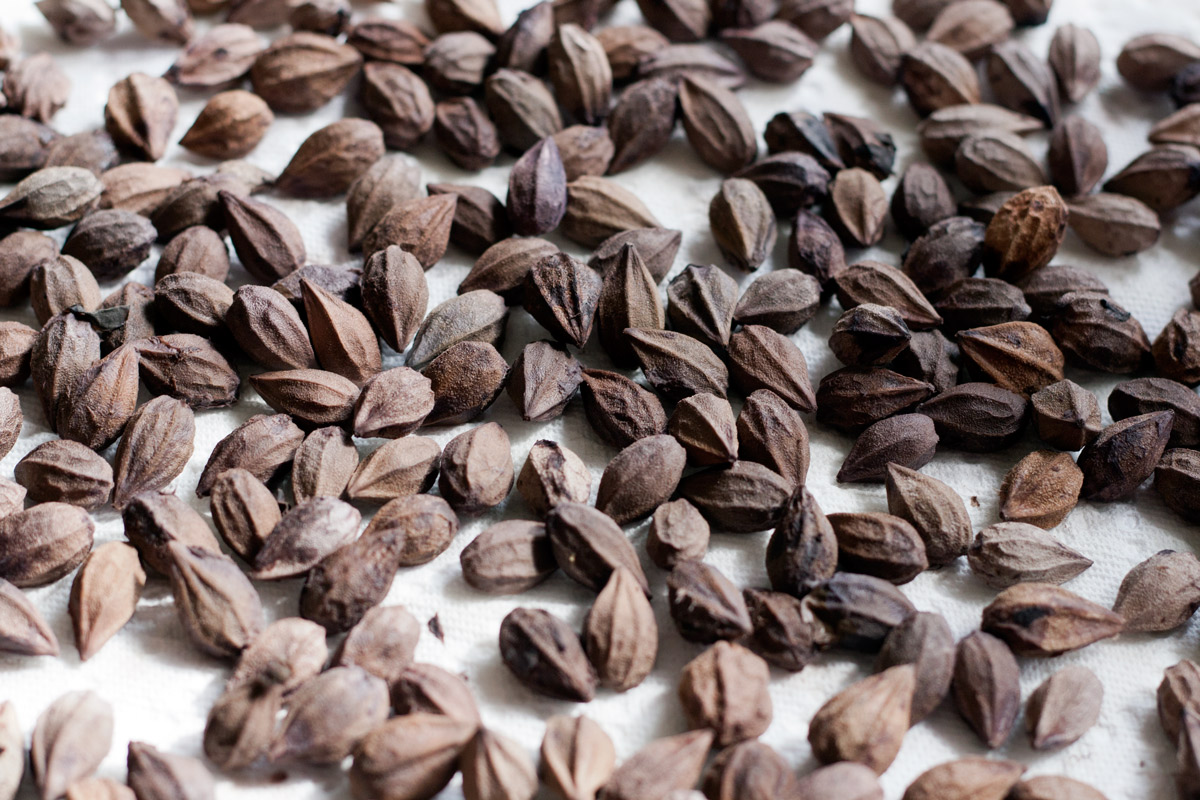


As you can see, the nut is in a segmented shell. This opens easily by pinching along the seams. The shell is in six segments, which I found fascinating. They are about the size of pistachios. Here is what the nut meat looks like:


I tried roasting the nuts but I like them better not roasted.

The yield was about two cups of pulp. I used the recipe for quick & easy freezer jam and followed the directions described for strawberries since cocoplums are not a well-known fruit. I stirred in one cup brown sugar and 3 cups white (mostly because I ran out of brown sugar). Stir the sugar into the fruit pulp and let sit for 10 minutes, stirring occasionally. While that is blending, add one box of pectin (1.75 oz) and 3/4 cup of water in a small pot and bring to a boil, stirring constantly. Boil for one minute. My pot wanted to boil over so I had to stir pretty fast and really reduce the heat. Once this is done, add the pectin liquid to the pulp/sugar mixture and stir until most of the crystals are melted. I heated the mixture a little but I'm not sure that was necessary. It should take about 3 minutes or so until it is smooth and not grainy. Pour the jam into clean, sterile containers and leave about a 1/2 inch gap at the top for expansion if you plan to freeze it. Cap them. (These are screw on lids.)


 Let it sit out for 24 hours and then refrigerate or freeze. It will keep in the refrigerator for about 3 weeks and in the freezer for about a year. I gave a lot of mine away to neighbors because I want to promote this yummy treat. You can use this jam in so many ways. Use it over meats, on desserts (it is great over key lime pie), on brie or goat cheese. Use it in vinaigrettes. Chop the nuts and stir them into the jam for a yummy conserve. Let your imagination soar. This is a dooryard fruit that needs to be explored.


Bon Appetit!

Other ideas:


Tuesday, July 3, 2012

If Clothes Make the Man…


Certain clothes make us feel a certain way and we behave differently depending on what we wear. When I wear work boots, I want to work and I definitely don’t want to hike Hickory Hammock in high heels. So this idea got me thinking… Does how we decorate our home affect how we feel about ourselves and our environment?

Take a minute and look around your house. Does it reflect what’s important to you, who you are and where you’d like to be?

When I looked around my house, as much as I love Florida, there was very little that represented my state. I had some books about Florida and a couple Seminole Indian dolls. That was pretty much it. Even my garden was comprised of maybe five or six native plants. I actually had more things from England than I did Florida. Why didn’t my home better reflect the Florida I love? 

Thus began my search. I went to home goods stores hunting for Florida accessories. It was frustrating. A typical conversation went something like this…

“May I help you?” the friendly sales woman asked.

“Yes. I’m looking for some Florida accessories for my home.”

A momentary blank look was followed by, “Oh, you mean like palm trees and shells,” she said, brightly.

“Well, is that all you have?”

“I think we might have some alligators, flamingos and maybe some dolphins.”

“Do you have anything distinctly Florida, like our orchids or some of our butterflies?”

She showed me some pillows with butterflies that only exist in someone’s imagination. The orchids are also of types not found in Florida. There are about 250 orchids native to the United State and about 50% of those are found in Florida; some are only found in Florida. The American Orchid Society is even based in Florida. As beautiful and important as orchids are, we have very few accessories with them. You have a much better chance of seeing a pillow with a lilac bloom, a lily of the valley, a tulip or a rose.

“Nothing with ghost orchids?”

“What?”

In general, you will find only those things which can be found in many other states: hibiscus flowers, shells, herons, pelicans, sea turtles, sand dollars. As full of exotic, beautiful, unique species as Florida is, it has been mostly ignored by the designers.  That was about to change.

When I told my former boss that I was going to launch a home accessories business to promote the unique beauty, history and culture of Florida, he said, “Nobody cares about Florida, Julie.”

I’m betting he was wrong.

Thursday, December 22, 2011

The Ghost Orchid

When choosing a logo, there are many things to be considered... I knew none of them.

All I knew was that I wanted it to symbolize the fragile, beautiful and exotic nature of my state. I wanted it to look old because our history was old. I wanted it to be different. No palm trees or shells for me, no sir! Palm trees and shells are everywhere, not just Florida. MY goal is to show the Florida most people don't know, and to champion those threatened or endangered, precious and overlooked facets of Florida's nature, history, culture and people. There is no compelling reason anyone should especially care about any of those things, and I knew that if I tried to make people care that I would fail. So I thought about what I might do to save what I could. I'm no evangelist or charismatic. I'm more likely to tick someone off with my preaching and lecturing. I was going to have to come up with a symbol to remind myself that I had to be subtle.

Years ago, a friend who knew of my love of orchids, good writing and Florida, suggested I should read THE ORCHID THIEF by Susan Orlean. Ms. Orlean's book was brilliant, painting the character and mystery of her subjects with a brush so fine and precise it was like reading a Flemish master. After reading her book, I needed to see a picture of a ghost orchid and I wanted to know more. (Ironically, my copy of the book has a phalaeonopsis orchid on the cover.) How could I have lived my whole life in Florida and not know of this flower? When I finally saw one, I was disappointed. I couldn't understand the big deal. Compared to other orchids, it was kind of... bland. It's white but not bright white. It has hints of green and a funny shape. All in all, there are much flashier, more beautiful orchids. It isn't large, has no leaves and rarely blooms. When it does bloom, you rarely see more than one flower and the likelihood of that flower getting pollinated is pretty remote. The pollinator is a moth, brown, large and mostly nocturnal. About the most interesting thing about the giant sphinx moth is it has an unusually long proboscis--about 5 inches. So why the fascination? And why choose this as our signature flower?

It grew on me. Haunted my subconscious. Floated in the background of my thoughts like a half finished puzzle. I came to realize that the ghost orchid epitomized all that had happened to Florida. The search for eternal youth, escape, the harsh abuses, the hopes, the struggle for existence, tenacity, and the sudden joyous surprise of something so rare it makes you cry.

Florida is not the most beautiful place on earth... except to those who love her. It isn't the answer to world peace or global warming. It's just a place to live, no better or worse than many others. But like all the places I've ever been, it has unexpected beauty, and like the ghost orchid, it is worth preserving.

Monday, August 8, 2011

In the Beginning

In the beginning there was a dream. Naturally. The dream grew out of a love for Florida and an earnest desire to share this love with the thousands of people who came to visit or settle here. Florida is an easy place to appreciate. The pleasant weather, beautiful beaches, cultural diversity and broad variety of activities make it a global desitination. Still, as with many popular locales, the unique and lesser known gems of Florida are in danger of being forgotten or lost.

And so was born our mission, a friendly mission, to educate, delight and invade your home with products that reflect the diverse and unique nature, culture,  and history of our beloved Florida. In this way, we hope to preserve what might otherwise be lost and to celebrate the new culture and progress brought by those who choose to make Florida their home.

Welcome to Distinctly Florida.